
Looking Back by Looking Forward
Diasporic communal memory is both a blessing and an inspiration

My favorite Holocaust museum in the world is located in Skopje, North Macedonia. This may seem an odd place for such an institution. Few people know of the rich Jewish history of the country, nor that 98% of the Jews in Macedonia were murdered in the Holocaust by the Nazis and their Bulgarian collaborators. (Today, there are only 200 Jews in the entire country of 1.8 million.) Yet, the destruction of this centuries-old community occupies just one of the several exhibits in the impressive space.
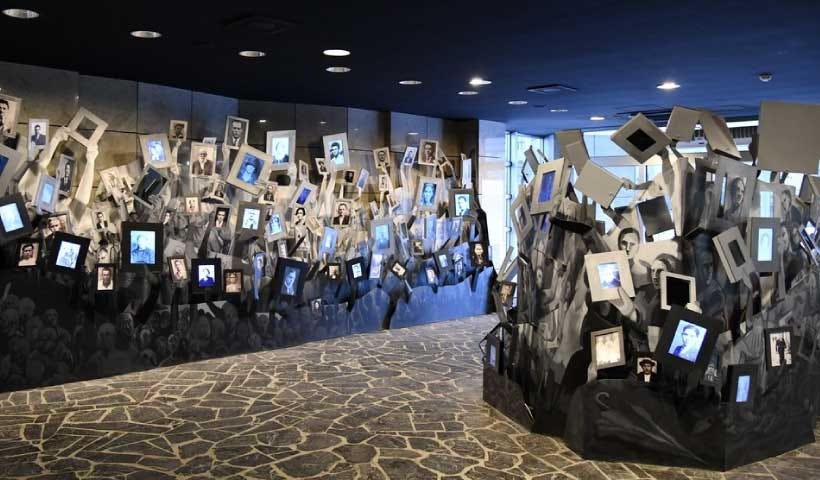
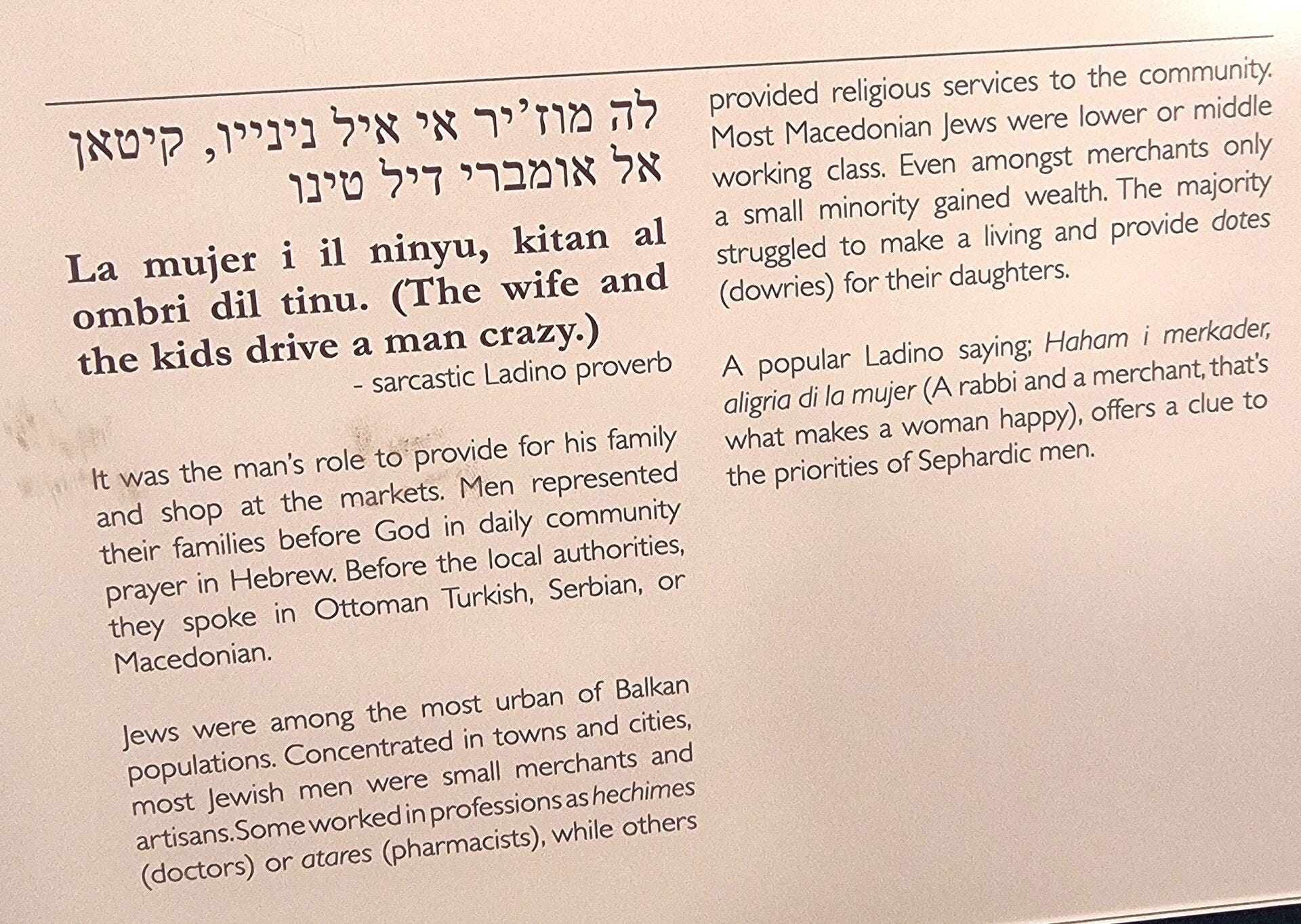
Upon entering the museum, one comes across a hall filled with multiple diorama displays: Rabbis in synagogues, sailors in Ottoman ports, and women baking Sephardic specialties like biscochos and bourekas. In the background, speakers play sounds of prayers and Ladino songs. The walls are papered in pages of Torah and Talmud, as well as Jewish newspapers on Balkan nationalism, Ottomanism, Socialism, and Zionism. An entire world is created in the confines of this museum. If I were an average Macedonian with no knowledge of Jews, I would leave this space with an appreciation for the Jewish people’s deep-rooted history in my country. I would also know and respect what makes them different from me.
I’ve seen many such museums and Holocaust memorial ceremonies in Jerusalem, New York, Berlin, and beyond. A commonality, unfortunately, between many of these is their emphasis on persecution and death. This framing, I’ll grant, is maybe not deliberate, but rather the outcome of a memory culture that has been internally and externally enforced. It’s a paradigm where we emphasize death without conveying life.
Mourning is chaotic, uncertain, messy — for the loss of one person, let alone for millions. Trying to fit it into a neat box can feel worse than saying nothing. Orwell articulated this prophetically in his essay On Politics and the English Language. When we rely on pre-manufactured phrases, clumsily cobbled together, we reduce such an unfathomably deep event to vague platitudes. Often, ceremonies like that leave me not with a feeling of meaningful mourning, but of frustrating mediocrity. I’ve wondered in the wake of such a poignant absence, how to pay honor to the memory of the victims, to the lives of the survivors, and to our continued carrying of their legacy, in a sensitive and meaningful way.
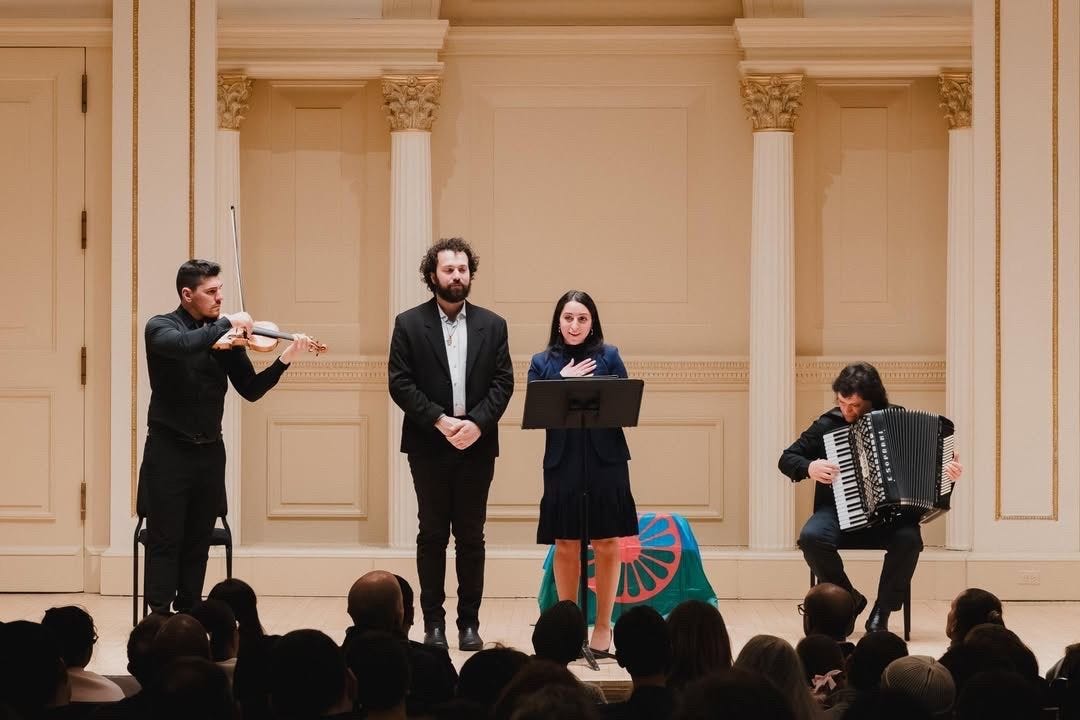
One event I attended recently felt like a taste of the way to do just that. Last week, I had the honor to represent the Jewish community at the Italian Consulate’s Holocaust commemoration ceremony1. This event was a joint memorial between Italy’s Romani community, and the Italian Jewish community. Among Romani, the Holocaust is called Samudaripen — “total destruction”, as Jews use the Hebrew Shoah.
The night, “A Concert of Remembrance”, had fairly little speaking. It was mainly songs, with some interspersed explanation. Alexian and Gennaro Spinelli, a father-son duo of masterful Romani musicians from Italy, brought a great diversity of work to life. This ranged from opera to symphony to folklore. The common thread in all these pieces was their influence by Romani musicians across Europe. This included classics like Bizet’s ‘Habanera’ from Carmen, or Brahms’ Hungarian Dance 5. It also included the less widely known — though famous for me — songs like Ederlezi (covered by Goran Bregović in Emir Kusturica’s 1998 epic Time of the Gypsies) and Djelem Djelem, the international Romani people’s anthem.
The music was riveting and lively. The elegant Italian cultural attaché sitting next to me whispered that she felt like dancing, so I joined her. We were on our feet dancing, in front row seats at Carnegie Hall, and the musicians kept playing and joined in with it. It felt like a true tribute to the legacy of this music, played for centuries around the world — not on polished stages, but in fields and roads, by common people.
Representing the Jews in this ceremony were my friend Nora Monasheri and I. Nora read the poem “Each of us has a Name” by Zelda. I read HaOmnam (Is it True) by Leah Goldberg — in Hebrew and English. The Spinellis played accordion and violin behind us, adding to the emotion. The son, Gennaro, read an original poem, “Auschwitz” in English, Italian, and Romani. I doubt many in the audience spoke Hebrew, nor did I know more than a few words of Romani. Yet I felt the connection, the soul depth of these poetic words and melodies.
The father Spinelli, a remarkable accordionist, concluded the concert saying, “If we have survived this long, it is only because our culture has survived. And our culture has survived because of, and through, our music. We don’t have a literary culture, but one of folklore passed down orally. This whole magnificent diversity of songs and music has influenced all of Europe and all of the world.” These words resonated with me in a personal way. The pain of the Shoah is not only the loss of lives, but the loss of cultural life. I think of all the culture, the lore, the literature — the Ladino, Yiddish, and Judeo-Greek linguistic corpus of my ancestors — all brutally erased.
I also wonder what my ancestors, lost in the Shoah, would have felt knowing that 80 years later their descendant would wear a tuxedo on stage at Carnegie Hall? On the other hand, surely they too went to the opera. It was simultaneously a humbling realization of how far we’ve come, and a chilling reminder that our success does not guarantee our security.
I left feeling both informed and invigorated — to learn more about Romani history and culture, more music and language. I felt an articulation of the feeling of kinship between our cultures, with their legacy of migration, diaspora, and inherited memory. Gratitude that the story of the Shoah has been told on page, stage, screen — and thinking of what we can do going forward as the last generation of survivors pass away.
Why did such a ceremony stick with me when so many others I’ve simply forgotten? It’s a few elements, which we can learn from and implement in the way we reflect and remember. Firstly, this ceremony named explicitly what it is that we are mourning: the death of millions of our compatriots. The erasure of their presence from the places they lived for centuries. It did not reduce this to vague platitudes about ‘evil’ and ‘humanity’. The story, and the hatred which allowed this destruction happen, did not begin with the war, nor end with it. Neither does that mean that we should seek victimhood or see any inherent righteousness in suffering2.
We best honor our ancestors’ lives by infusing our own lives with substance. We must learn not just their stories of survival, but learn the depth and color of their world. In the Jewish memorial prayers, we say that we pledge to give tzedaka (charity) in memory of someone who has passed away. In that spirit, we should let the memory of our lost ancestors inspire us to tradition, values, and practice — not to let the Shoah memorial be the only Jewish event we attend all year3. Thank God, we have many opportunities throughout the year to not just commemorate but to learn, and to celebrate our tradition with vitality in the present.
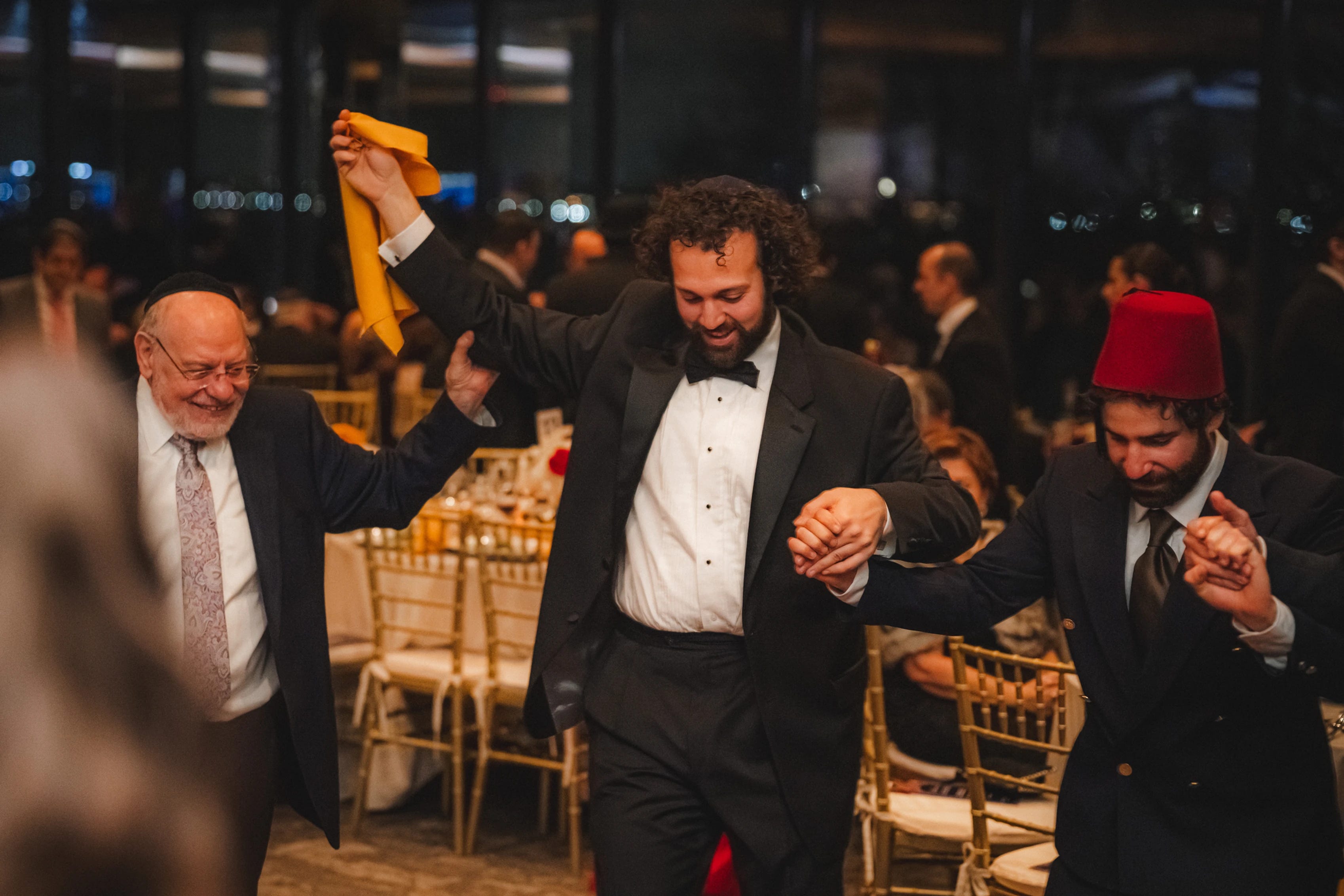
Ultimately, it is only from that place of particularity, of knowing our own tradition, that we can effectively build bridges to other communities. I was happy to be part of this ceremony, not as a token, but as a partner and a peer. My knowledge of Romani culture and history may be more than the average American’s, but it is nevertheless limited. I came out knowing more — not only about our shared histories of persecution, but with an appreciation for the ability to maintain community links for centuries despite that persecution. For the way in which we are a diasporic people who maintain that unity. In other words, the Romani, like the Jews, are multi-rooted.
Walking out of Carnegie Hall into the frigid cold, I felt the bitter bite of the weather, and yet an uplifting sense: that we have taken a small chip away at the perhaps insurmountable mass of memory and loss. One piece at a time, we have a way forward.
Props to my friend Ioio at UGEI (Jewish Youth of Italy) and my friend Dezdemona at the International Romani Youth Organization for the work both of them do in keeping our traditions alive and vibrant!
To this point I recommend this and last year’s State of World Jewry Addresses. Combined, both make the case that we should invest less in the “fight against antisemitism” and more in making Jewish life and education enriching and accessible.
To this I recommend the work of Dara Horn, author of the widely-read essay collection People Love Dead Jews. A major theme in her work is criticizing the over-emphasis of Holocaust education, and working to supplement that with education which explains the rich history of the Jewish people in a positive and substantive way.